A Rainy-Day Rewatch for Watching How People Listen
A rainy-day rewatch for watching how people listen reveals how timing, gaze and stillness shape conversational scenes without turning gestures into clues.
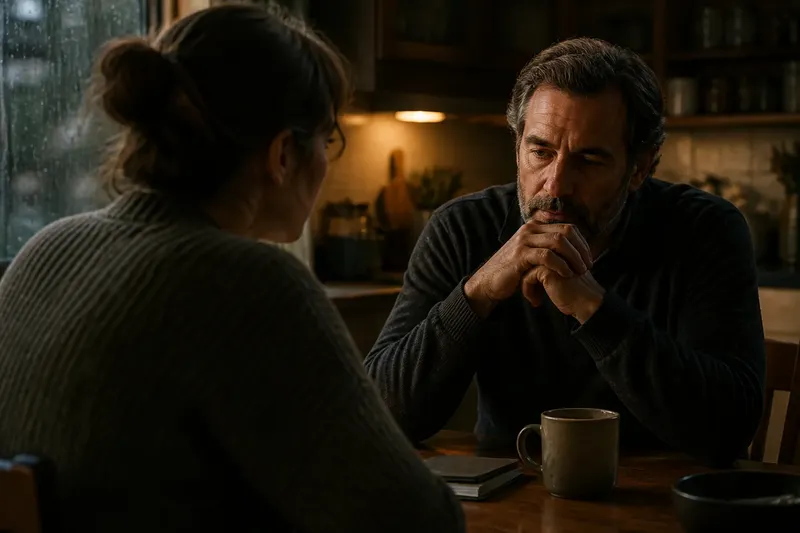
The common mistake in a rainy-day rewatch is to watch a conversation for conspicuous gestures and treat each one as evidence: folded arms mean distrust, a glance away means a lie. That shortcut costs you the scene. Listening on screen is less a code than a changing relationship between two people, shaped by when one responds, where attention rests and what the body does while speech continues.
Use one conversational scene, not a whole film. Choose a passage with at least two speakers and little action beyond talking: a kitchen exchange, an interview, an argument at a table. Watch it once without pausing, then return to it with a different question each time. The point is not to diagnose the characters. It is to notice the performance choices that make attention feel active.
Choose one scene
Pick a scene long enough for the balance of a conversation to shift, but short enough to hold in mind. A scene from a familiar film can be useful because you are less occupied by plot. An unfamiliar one can work too, provided the exchange is easy to follow. Avoid a passage whose main business is a reveal, a chase or a speech delivered to a crowd; those ask for other kinds of attention.
If you are watching at home, keep the playback controls nearby and use subtitles if dialogue is hard to catch. Do not begin by looking up the actors’ intentions or the director’s notes. A prior explanation can make a performance seem like an illustration of someone else’s claim, which is a tidy way of missing what is actually on screen.
Say you choose an invented scene in which a daughter tells her father she has accepted a job elsewhere. On the first viewing, you notice that he asks about the train rather than the job. On later passes, you can follow how the actors make that deflection legible without deciding that one glance or pause has a fixed meaning.
Watch without pausing
Let the scene run from beginning to end. Keep your attention on the exchange as a whole: who sets its pace, who changes the subject, and whether one person’s reply seems to meet the other person’s point. Do not take notes yet. A first pass gives you the scene’s ordinary rhythm, against which smaller timing choices can register later.
Afterwards, recall one moment when the conversation seemed to change direction. It might be a reply that arrives late, a question left unanswered, or a speaker who carries on while the listener does not move. Choose one moment only. If you try to record every pause and look at once, you are likely to make a ledger of gestures rather than watch two people relate.
On the invented job scene’s first pass, perhaps the father’s question about the train feels practical, almost casual. Keep that impression as a description, not a verdict. “He turns towards logistics” is observable; “he is secretly pleased” is an interpretation that needs more than a single exchange.
Track the timing
Replay the selected passage and listen for the intervals around speech. Does the listener answer as soon as the other person finishes, begin before the sentence is complete, or wait until a silence has opened? Does the speaker allow that silence to remain, or fill it with another question? Timing matters because conversation is not simply a line of dialogue followed by a line of dialogue. The space between them can carry a change in willingness, confidence or control.
Notice the difference between a pause that belongs to the listener and one imposed by the speaker. A listener may need time before answering, but a speaker can also continue, interrupt or ask a new question before an answer has room to arrive. The performance is in the relation between those events, not in the pause as an isolated object.
Try a brief notation: write down the spoken line, then mark “overlap”, “short gap” or “longer silence” where appropriate. No stopwatch is needed. The aim is to remember the shape of the exchange, not to turn acting into a timing exercise. On the invented scene’s second pass, you might hear the daughter leave a small gap before answering the train question. That gap could suggest hesitation, care or simply a search for words; the following lines help you judge what it does in context.
Follow the gaze
Watch the scene again, this time attending to where each performer looks while listening. Do they hold the other person’s gaze, look towards a shared object, glance away during a difficult sentence, or return their eyes when they speak? Notice when the gaze changes, not just where it lands. A look that shifts as the subject changes can make attention feel responsive; a fixed gaze can feel intense, polite or blank depending on the moment around it.
Include the camera’s contribution in your observation. A close shot can make a small eye movement prominent, while a wider frame may leave it as one element among posture, distance and the surrounding space. If the scene cuts to the listener during a line, the edit directs your attention there. The actor’s performance and the film’s choice to show it work together, so do not credit every effect to the performer alone.
In the invented job exchange, imagine the father looks at his daughter while she speaks about leaving, then lowers his gaze when she mentions the new place. That shift is worth noticing. It does not, by itself, tell you whether he is worried, resentful or searching for a tactful reply. Watch what he does next and how she responds before forming a reading.
Notice stillness and movement
For another pass, attend to movement in the listener. Look beyond large gestures. A hand that stops moving, a body that turns slightly towards the speaker, or a face that remains quiet while the voice continues may all shape the exchange. Compare the listener’s behaviour during different kinds of speech: an ordinary detail, a direct question, a subject that seems harder to address.
Stillness is not automatically attention. A motionless performer can seem absorbed, guarded, distracted or simply at rest. Likewise, movement does not necessarily mean impatience. What matters is whether a change in the body coincides with a change in the conversation and whether the other performer appears to register it. Read the scene as an interaction, not a collection of symbols.
It can help to divide the scene into three broad moments: before the difficult subject, during it and after it. Ask what changes in each moment, if anything. Do not force a change to appear. Some of the most convincing listening is consistent because the character’s attention does not need to announce itself with a new gesture.
Compare what the scene gives you
Now replay the scene once more, following only one speaker at a time. First watch the person listening; then watch the person speaking. The change of emphasis can reveal how a reply is prepared, delayed or redirected. It can also show where the scene gives you too little to be certain. That uncertainty is useful. A performance may leave room for several plausible readings rather than supply a hidden answer.
For the invented father and daughter, imagine the daughter hears his train question, pauses, then answers it plainly before returning to the job. The observable sequence is question, pause, practical answer, renewed focus. It may suggest that she understands his deflection and chooses not to confront it yet. It may also be an ordinary attempt to keep the conversation moving. The scene’s later exchange can support one reading, complicate it or leave the matter open.
Write two short notes at the end: one about the performance you can point to, and one about what you infer. “He waits before answering and looks away” belongs in the first. “He wants to avoid the subject” belongs in the second. Keeping them separate makes analysis sharper without pretending that acting supplies a codebook.
Questions worth asking?
What should I watch first in an acting scene?
Watch the full exchange once for its rhythm and direction before isolating a pause, look or movement. That first pass gives each detail a conversational context instead of making it carry the whole interpretation.
Does looking away mean a character is dishonest?
No single gaze direction has a reliable meaning across scenes. Consider what was said, how the listener responds, how the other performer reacts and what the camera chooses to show.
How can I tell whether a pause is deliberate?
You cannot know the performer’s private intention from the finished scene alone, and you do not need to. You can describe where the pause falls and how it changes the exchange, then keep any explanation as a reading rather than a fact.
Should I watch with subtitles?
Use them if you need them to follow the words, especially when quiet speech or overlapping dialogue is hard to hear. For a later pass, try watching without reading every line so your attention can return to faces, timing and stillness.
Keep the notes modest
One scene and a handful of observations are enough for a useful rewatch. There is little value in pausing on every blink, marking each breath or assigning a meaning to every movement. That labour produces a neat record and often a less attentive viewer. Return to the whole exchange when an isolated detail begins to look too certain.
A rainy-day rewatch for watching how people listen works best when it leaves some questions unresolved. Note the timing, gaze and stillness you can actually see; then notice how those choices alter the way the conversation feels. The next time you watch the film, you may hear a reply differently, which is a more useful result than deciding that one glance has cracked the character.