The Room That Remembers Who Lives There
Learn how repeated-use details make a film room feel inhabited, giving viewers a sense of life beyond the scene without adding explanatory dialogue.
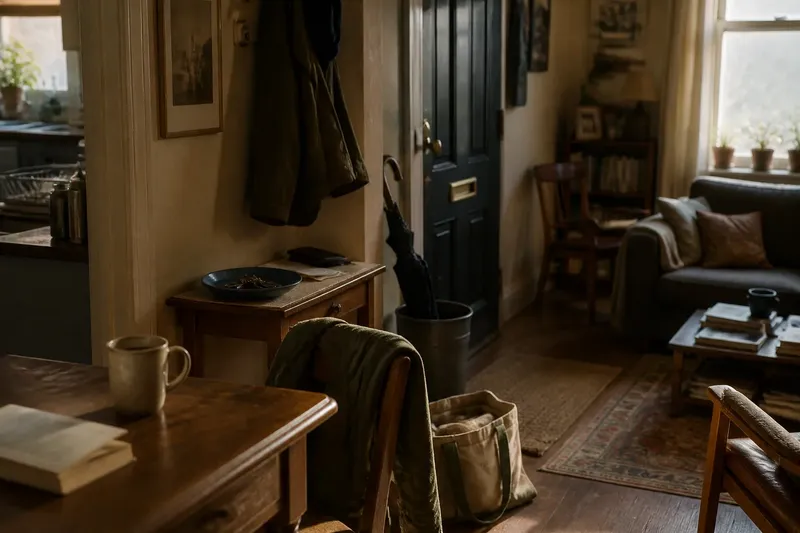
The common mistake in film worldbuilding is to dress a room for a scene and leave it at that. The result can cost the story a quiet source of character: a place that looks borrowed whenever the camera returns. Repeated-use details make a room feel inhabited. A mug with a habitual place, a chair angled towards a window or a coat that never quite reaches its hook can imply life outside the scene without asking an actor to explain it.
The aim is not to scatter signs of disorder. It is to establish a small pattern, then let the audience recognise it. Treat this as a week-long preparation routine, adjusted to the production’s schedule. The room need not become a biography. It needs a few traces that belong to the person who uses it.
Monday: Find the room’s routine
Start with the character’s ordinary passage through the space. Where do they enter? What do they set down first? Which surface do they use while distracted, tired or in a hurry? These questions point towards a room’s repeatable actions rather than its decorative theme.
Choose one everyday object that naturally returns: a set of keys, a paperback, a tea tin or a pair of glasses. Give it a resting place that makes practical sense. A shallow dish beside the door is more persuasive than keys arranged neatly on a distant mantel, unless the character has a reason to prefer the mantel.
Then choose one secondary trace that follows from the routine. A chair may be pulled out because the character sits there to remove boots. A folded towel may hang near the sink because it is used often. Each detail should have a clear relationship to an action, not merely a pleasing shape in the frame.
Tuesday: Test the pattern
Write down the routine in plain verbs: enter, drop, sit, reach, leave. This is not dialogue or a character dossier. It is a compact account of how the room is used. If an object cannot be attached to one of those actions, ask whether it is doing useful work or only taking up attention.
Check the pattern against the scene. A recurring place for an object should remain visible when the audience needs to register it, but it need not be framed like a clue. The viewer can notice a familiar shape in the background while following the conversation. The room is not asking for applause.
Consider who else uses the space. A shared kitchen may have one person’s favourite mug, but other cups should not look like they were arranged by a museum curator. A bedroom used by one character can carry a more particular routine. The room’s ownership should be legible without making every surface a personality test.
Wednesday: Build the lived-in details
Choose objects that can be handled consistently. A ceramic mug, a cloth shopping bag or a stack of post can return across scenes without demanding elaborate explanation. For a recurring place, use a surface or landmark that is easy for the cast and crew to identify: the left corner of a kitchen counter, the hook beside the door, the shelf under a mirror.
Keep the arrangement plausible for the action. If the actor needs to put down a bag while speaking, the landing place should be within reach and clear enough to use. If a prop must be picked up later, its position should be simple to restore between takes. The practical demand is not separate from the storytelling: a repeated action that works smoothly is easier to perform without fuss.
Imagine a character who comes home carrying a canvas shopping bag and a damp umbrella. Their keys always go into a blue dish on the entry table. The bag lands on the chair because the table is narrow, and the umbrella rests in a bucket by the door. In a later scene, the empty chair and keys in the dish still suggest the same routine, even though the character is absent. That is the useful effect: the room’s arrangement points to a life, not a puzzle.
Thursday: Plan the returns
Map where the room appears in the script, including scenes that share the same setting but not the same mood. Mark which details must remain in their established places and which may change through ordinary use. A half-finished cup might be cleared between scenes; the familiar place for the keys should not drift without a story reason.
Make a simple continuity record with a room photograph and a few written notes. Record the position of the important objects, whether a drawer is open, and any visible change in the scene. The aim is not to document every crumb. It is to preserve the handful of repeated-use details that carry recognition from one appearance to the next.
If the character’s routine changes, show the change through the room rather than announcing it. The mug left in the wrong place may be enough if the audience already knows its usual place. Keep that departure clear and limited. A whole room rearranged at once can read as a new set rather than a changed habit.
Friday: Rehearse the ordinary
Walk the actor through the room’s routine before filming the scene. They might enter, place the keys, move the chair and reach for the mug as part of the action. The movement should fit the character’s immediate intention. If it feels like a tour of the set, simplify it.
For a scene in which the routine is interrupted, decide what the interruption leaves behind. Perhaps the keys remain in the actor’s hand, or the chair stays pushed in. That unfinished action can give the room a temporary difference without adding a line of exposition. Keep the distinction between a habitual arrangement and a deliberate story change clear to the crew.
It is not worth giving every room a signature object or making each repeated detail symbolise a wound, secret or turning point. Some objects are just useful. Ordinary use is often enough; the audience does not need a lecture from the furniture.
Saturday: Check the camera’s view
Look at the set through the intended camera positions. A detail that reads clearly in a wide shot may vanish when the scene is covered more tightly. If a recurring place matters, give it a fair chance to appear, but do not force a close-up unless the story calls for one.
Check sightlines, actor movement and the background together. A lamp, doorway or extra chair may obscure the object’s usual place. Move the arrangement only if the new position still makes sense for the character’s routine. The room should support the scene’s blocking, not sabotage it for the sake of an attractive still image.
Also check that repeated objects can be reset. If a prop is consumed, folded or moved during a take, note what the next scene requires. Continuity is less mysterious when the set has a clear baseline and the departures from it are intentional.
Sunday: Review the pattern
Watch the scenes in order, or read them beside the continuity photographs if the edit is not available. Ask whether the room feels used before the first close view, whether its repeated detail is recognisable on return, and whether any change has a visible cause. If viewers would need dialogue to understand a routine, the physical pattern may be too faint. If the object draws attention before the character does, it may be too emphatic.
Use these questions to make the final adjustment:
- Does the object have a believable resting place?
- Can the actor reach or move it as part of ordinary behaviour?
- Does the room still work for shared use and scene blocking?
- Are returns consistent, with changes recorded?
- Can the detail be noticed without being framed as a revelation?
Where a prop’s handling or placement depends on the production’s instructions or local requirements, follow those instructions rather than improvising for visual effect.
Questions about lived-in rooms?
How many repeated details does a room need?
Begin with one strong routine and a small number of connected traces. Add another only if it expresses a different, useful action; a crowded set can make every object compete for notice.
Should the same object appear in every scene?
No. It should appear when the character’s routine or the camera’s view makes its presence plausible. Its usual place can remain meaningful even when the object is temporarily elsewhere.
How can a room suggest absence?
Keep the habitual arrangement visible and remove or interrupt one expected action. An empty chair where a bag usually rests can imply that someone has not returned, provided the audience has already seen the chair used that way.
What if the setting is shared?
Let routines overlap. A shared shelf can show one person’s regular place alongside another’s less orderly use, without assigning every object a single owner. The resulting pattern should feel practical before it feels symbolic.
The room that remembers who lives there does so through small, repeatable actions. Establish the place where ordinary objects land, preserve it when the story requires continuity, and change it only when a character’s behaviour gives the change a reason. That is enough to let the setting carry a little life beyond the scene.