How Screen History Changed the Hand Prop
Trace how silent cinema, early sound and later close framing changed the hand prop, with named film examples that clarify each shift for screen storytellers.
The common mistake in writing a screen history of the hand prop is to treat it as a timeless symbol. A key in a silent film, a telephone in an early sound picture and a close view of a hand in a later film belong to different filmmaking conditions; flatten them into one idea and the history disappears.
Here, “hand prop” means an object an actor handles on screen. Its function has changed less by a neat march towards subtlety than by shifts in performance, sound, framing and editing. A few named films make those changes easier to see.
Silent action
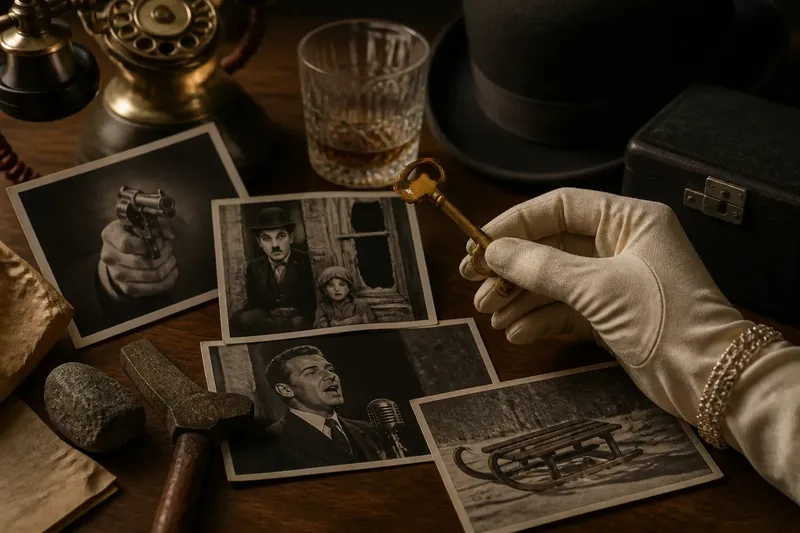
In The Great Train Robbery (1903), Edwin S. Porter uses a close view of a bandit firing directly towards the camera as a separate, emphatic image. It is not a small pocket object, but it shows an early screen convention clearly: the prop can make an action legible through its handling and placement in the frame.
By the time of Charlie Chaplin’s The Kid (1921), objects could be part of a more sustained comic routine. The Tramp and the child work together to break windows and sell repairs. The glass, stone and tools are not decorative details; they organise the sequence’s action and make the characters’ scheme visible without dialogue.
Silent films were not limited to broad gestures, and a prop did not need to be held up like evidence. But without recorded dialogue, an object’s use, the actor’s movement and the arrangement of the image often carried information that later films could also deliver through speech or sound.
Sound and handling
The Jazz Singer (1927) is commonly associated with the arrival of synchronised spoken sequences in a feature film, though silent production continued alongside sound. The change was not simply that objects acquired noises. Sound films could coordinate speech, pauses and physical action in a scene, giving the handling of an object another possible source of emphasis.
A telephone can interrupt dialogue; a glass can be set down during a pause; a latch can click as someone leaves. These sounds do not make an object inherently dramatic. Their effect depends on what the characters are saying and doing around them, and on whether the film chooses to make the sound prominent.
That distinction matters for production. A metal clasp, a paper envelope and a plastic case have different handling and sound qualities. If the action depends on a particular noise, the script and sound plan can identify it. If it does not, specifying a dramatic click may add work without adding meaning.
Framing the hand
Close framing had existed in cinema before sound; it was not invented by the later close-up. What changed across film styles and periods was how readily directors could move attention from the room to a face, hand or object, and how editing could make that detail part of a sequence.
In Notorious (1946), Alfred Hitchcock uses a close view of a key in Alicia’s hand to make a small object central to the scene’s suspense. The key matters because the story has established what it opens and why its possession is risky. The framing concentrates attention; the surrounding action supplies the stakes.
This is a useful contrast with the more outwardly legible business of many silent routines. A prop can now be given emphasis through a brief insert or a hand entering the frame, rather than through a broad gesture. The method is not automatically more sophisticated. It is simply a different way to direct attention.
Objects beyond use
Later cinema often lets an object carry associations across a film, but that practice has older roots. In Citizen Kane (1941), the word “Rosebud” and the childhood sled become part of an inquiry into a life. The sled’s significance comes from the film’s structure and final reveal, not from the object possessing a universal meaning on its own.
That distinction keeps historical comparison honest. A prop may be an instrument of action, a source of sound, a point of visual emphasis or a recurring motif. Films can combine these functions, but none follows automatically from the object’s age, material or size.
For screenwriters, the period-specific question is what the film’s form lets the object do. A silent sequence may need the action to read through gesture and composition. A sound scene can use an interruption or pause. A close insert can narrow attention, provided the story has already given the audience a reason to care.
What changed on screen?
Did silent films use close-ups?
Yes. Close views existed in silent cinema, though their frequency and purpose varied by film and filmmaker. The later use of a close-up should not be mistaken for the invention of the technique.
Did sound make props more important?
Sound added dialogue and audible handling as options, rather than making every prop more significant. A sound matters when its timing or presence changes how the scene is understood.
Why is the key in Notorious memorable?
The key is tied to a specific danger in the plot, and Hitchcock’s framing directs attention to it. Its importance comes from that scene and story context, not from keys being inherently suspenseful.
What can a screenwriter take from this history?
Choose the means of emphasis that suits the scene: gesture, dialogue, sound, framing or repetition. The object should alter the action or the audience’s attention; otherwise, it may be stage dressing.
Useful period choices
- Check whether a silent scene’s action reads through gesture and composition; if it does not, clarify the handling or the actor’s movement, or remove the prop-dependent beat.
- Check whether a sound-era scene depends on an object’s noise; if the sound changes the pause or decision, specify the audible action, or leave it unaccented.
- Check whether a close view has a story reason, as the key does in Notorious; if the audience needs the detail, establish its stakes, or keep the action in a wider shot.
- Check whether a recurring object has a defined role, as the sled does in Citizen Kane; if later recognition matters, establish the object earlier, or avoid presenting it as a mystery clue.
- Check whether a period scene relies on dialogue to explain an action that should be visible; if the action must read without speech, make the prop’s use clear, or revise the beat so dialogue carries the information intentionally.
- Check whether the prop’s sound is practical for the intended scene; if the sound needs emphasis, include it in the sound plan, or choose an action that communicates without it.
Say you are writing a silent-era scene in which a clerk discovers that a letter has been opened. The starting inputs are a sealed envelope, a desk, and no dialogue. First, have the clerk compare the broken seal with the intact seal on a second letter; next, let the clerk look towards the office door before hiding the opened envelope beneath a ledger. The observable result is a sequence the audience can follow: the letter was tampered with, the clerk suspects someone nearby, and the clerk chooses concealment. If the seal cannot be read from the planned framing, make the break larger or show the comparison in a closer view; a spoken explanation is not the only available repair.
Effort and emphasis
It is not worth the effort to assign an elaborate symbolic history to every handled object, or to specify a distinctive sound when it changes nothing in the scene. Period detail is useful when it clarifies what an actor can do, what the audience can perceive, or how a film directs attention.
The main search phrase, hand prop in film history, points to a changing set of screen choices rather than a single evolution from obvious gesture to hidden meaning. When shaping a scene, identify the object’s job in that particular film: action, sound, emphasis or recurrence. That choice is more precise than asking the prop to represent an era by itself.